

A Complete Medical Guide to Diagnosis, Procedure, Benefits, Risks & Recovery
Venous Leakage Embolization is an advanced, minimally invasive interventional radiology procedure designed to treat venogenic erectile dysfunction (ED). In this condition, the veins in the penis fail to retain blood during an erection properly. Unlike traditional erectile dysfunction treatments that focus on improving blood inflow, this procedure specifically targets excessive venous outflow, restoring the body’s natural erectile mechanism.
In this comprehensive medical guide, we will explain:
- What venous leakage is
- Causes and symptoms
- How it is diagnosed
- What Venous Leakage Embolization involves
- Benefits and success rates
- Risks and recovery
- Comparison with other ED treatments
- Frequently asked questions
Understanding Venous Leakage (Venogenic Erectile Dysfunction)
What Is Venous Leakage?
Venous leakage, also known as venogenic erectile dysfunction, occurs when blood enters the penis normally during arousal but escapes too quickly through the veins. As a result, a firm erection cannot be maintained long enough for satisfactory sexual performance.
An erection requires two critical mechanisms:
- Increased arterial blood inflow
- Restricted venous outflow
When the venous occlusion mechanism fails, blood drains prematurely — causing partial erections or erections that quickly subside.
Causes of Venous Leakage
Venous leakage can affect men of various ages, though it is more common in younger men with persistent ED that does not respond to oral medications.
Common causes include:
- Congenital venous valve weakness
- Pelvic trauma or injury
- Penile surgery
- Diabetes-related vascular damage
- Peyronie’s disease
- Hormonal imbalances
- Aging-related tissue degeneration
Some patients develop venous leak without a clearly identifiable cause.
Symptoms of Venogenic Erectile Dysfunction
Men with venous leakage often report:
- Difficulty maintaining erections
- Erections that soften quickly during intercourse
- Good initial rigidity that fades
- Poor response to medications like Sildenafil (Viagra)
- Need for constant stimulation to maintain an erection
Unlike psychogenic ED, venous leakage has a physical vascular origin and typically persists regardless of emotional factors.
How Is Venous Leakage Diagnosed?
Accurate diagnosis is crucial before considering embolization.
1. Penile Doppler Ultrasound
The most common diagnostic tool is Penile Color Doppler Ultrasound. After injection of a vasoactive drug, blood flow patterns are analyzed.
Findings suggestive of venous leak include:
- Normal arterial inflow
- Persistent high venous outflow velocity
2. Dynamic Infusion Cavernosometry and Cavernosography (DICC)
This specialized test measures intracavernosal pressure and identifies leaking veins.
3. CT Cavernosography
In some centers, CT imaging is used to map abnormal venous drainage before embolization.
A proper vascular assessment by an experienced interventional radiologist is essential.
What Is Venous Leakage Embolization?
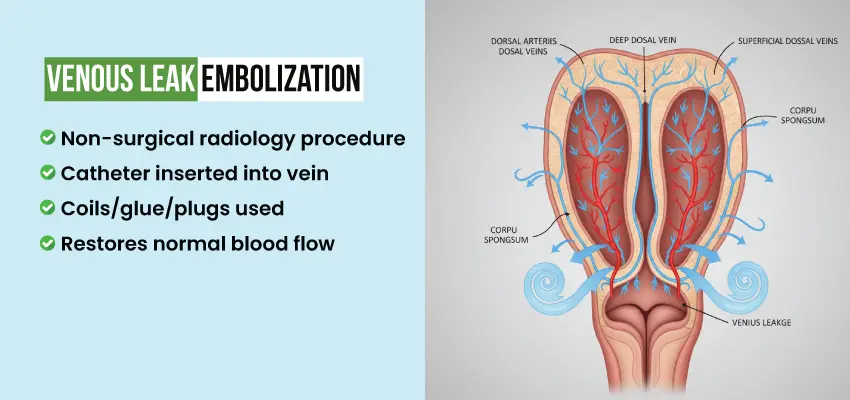
Venous Leakage Embolization is a minimally invasive image-guided procedure performed by an interventional radiologist to close abnormal penile veins responsible for excessive blood drainage.
The procedure works by:
- Identifying leaking veins
- Blocking them using embolic materials
- Restoring normal blood retention during erection
It is performed without major surgery and typically does not require general anesthesia.
How the Procedure Works
Step 1: Local Anesthesia
The procedure is usually done under local anesthesia with mild sedation.
Step 2: Venous Access
A small catheter is inserted through a vein in the groin or neck under imaging guidance.
Step 3: Venography
Contrast dye is injected to visualize abnormal venous drainage pathways.
Step 4: Embolization
Once the leaking veins are identified, embolic materials are deployed. These may include:
- Coils
- Medical glue
- Sclerosant agents
The goal is to permanently block the abnormal veins.
Step 5: Completion Imaging
Final imaging confirms adequate closure of targeted veins.
The entire procedure typically takes 60–120 minutes.
Mechanism of Action
In normal physiology, the tunica albuginea compresses the veins during erection, preventing blood from escaping. In venous leakage, this compression mechanism is insufficient.
Embolization:
- Reduces venous drainage
- Increases intracavernosal pressure
- Allows natural erection maintenance
It restores the hydraulic balance necessary for sexual performance.
Who Is a Candidate for Venous Leakage Embolization?
Ideal candidates include:
- Men diagnosed with venogenic ED
- Poor responders to PDE5 inhibitors
- Younger men with isolated venous leak
- Patients wanting a minimally invasive alternative to implants
Not ideal for:
- Severe arterial insufficiency
- Psychological ED
- Advanced diabetes with multi-factor ED
- Untreated hormonal disorders
A thorough evaluation by a vascular specialist is necessary.
Benefits of Venous Leakage Embolization
1. Minimally Invasive
No major surgery, stitches, or large incisions.
2. Outpatient Procedure
Patients go home the same day.
3. Preserves Natural Anatomy
Unlike penile implants, it does not replace erectile tissue.
4. Quick Recovery
Most patients resume normal activity within a few days.
5. Drug-Free Solution
May reduce dependency on medications like Tadalafil (Cialis).
Success Rates of Venous Leakage Embolization
Success depends on:
- Patient selection
- Severity of venous leak
- Technique used
- Experience of a radiologist
Published studies show:
- Improvement rates between 60%–80%
- Best outcomes in younger patients
- Higher success in isolated venous leak cases
Long-term data is still evolving, but early results are promising.
Risks and Complications
Although generally safe, potential risks include:
- Bruising at the catheter site
- Mild pain or swelling
- Temporary erectile discomfort
- Non-target embolization (rare)
- Recurrence of leakage
Serious complications are uncommon when performed by experienced specialists.
Recovery After Venous Leakage Embolization
Immediately After Procedure
- Observation for a few hours
- Mild soreness may occur
First Week
- Avoid heavy lifting
- Abstain from sexual activity (usually 1–2 weeks)
Follow-Up
- Doppler ultrasound after several weeks
- Gradual resumption of sexual activity
Most men return to work within 1–3 days.
Comparison With Other Erectile Dysfunction Treatments
Oral Medications
Drugs like Sildenafil increase blood inflow but do not correct venous leak.
Pros:
- Easy to use
- Widely available
Cons:
- Temporary effect
- Ineffective in venous leak
Vacuum Erection Devices
Create mechanical erections, but may feel unnatural.
Penile Implants
Surgical insertion of a prosthesis.
Pros:
- High satisfaction rate
Cons:
- Invasive surgery
- Irreversible
- Infection risk
Venous Leakage Embolization
Pros:
- Minimally invasive
- Preserves natural erection
- Treats the root cause
Cons:
- Not effective in all ED types
- Requires specialized expertise
Long-Term Outlook
Venous embolization is a promising therapy in interventional andrology. With improved imaging techniques and better embolic materials, outcomes continue to improve.
Ongoing research is focused on:
- Refining patient selection
- Improving long-term durability
- Combining embolization with regenerative therapies
Frequently Asked Questions (FAQs)
Is Venous Leakage Embolization Permanent?
In many cases, yes. However, new collateral veins may develop over time.
Is the Procedure Painful?
Most patients report minimal discomfort due to local anesthesia.
How Soon Can Results Be Seen?
Some patients notice improvement within weeks; full results may take 1–3 months.
Can It Replace ED Medication?
Many patients reduce or stop medication, but this varies individually.
Is It Safe?
When performed by experienced interventional radiologists, it is considered safe with low complication rates.
Cost of Venous Leakage Embolization
Costs vary depending on:
- Country
- Hospital setting
- Imaging techniques used
- Embolic materials
It is typically more affordable than surgical implants but may not be covered by insurance in all regions.
Why Early Diagnosis Matters
Ignoring venogenic ED can:
- Affects mental health
- Strain relationships
- Reduce quality of life
Early vascular evaluation allows targeted treatment instead of trial-and-error medication use.
The Future of Erectile Dysfunction Treatment
Venous Leakage Embolization represents a shift toward precision vascular therapy in sexual medicine. Instead of masking symptoms, it addresses structural abnormalities directly.
As awareness increases and more interventional radiologists adopt this technique, it may become a standard option for properly selected patients.
Final Thoughts
Venous Leakage Embolization is an innovative, minimally invasive solution for men suffering from venogenic erectile dysfunction. By targeting abnormal venous drainage, it restores the body’s natural erectile function without major surgery.
For men who:
- Do not respond to oral medications
- Want to avoid implants
- Have confirmed venous leakage
This procedure offers hope backed by evolving clinical evidence.
If you suspect venous leakage, consult a qualified urologist or interventional radiologist for proper diagnostic evaluation. Personalized medical assessment remains essential for safe and effective treatment.