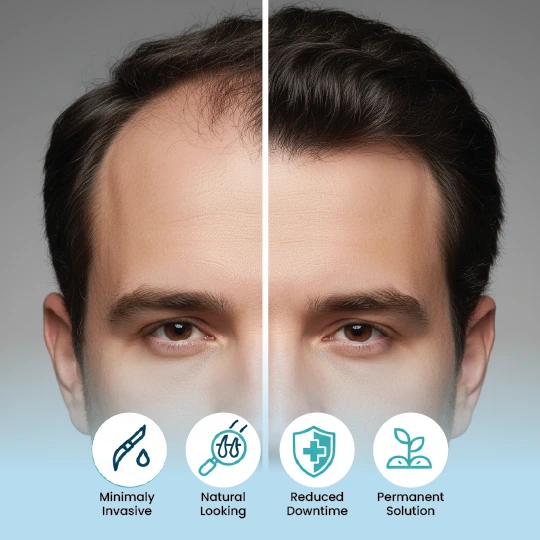
FUE Hair Transplant
Procedure Details, Cost & Complications in PakistanFUE hair transplant is a permanent, no-stitch surgery where individual hair follicles are moved from the back of your scalp to bald areas. The procedure must be performed by a certified plastic surgeon, takes 6–8 hours, and costs between PKR 70,000–250,000 depending on the number of grafts needed.
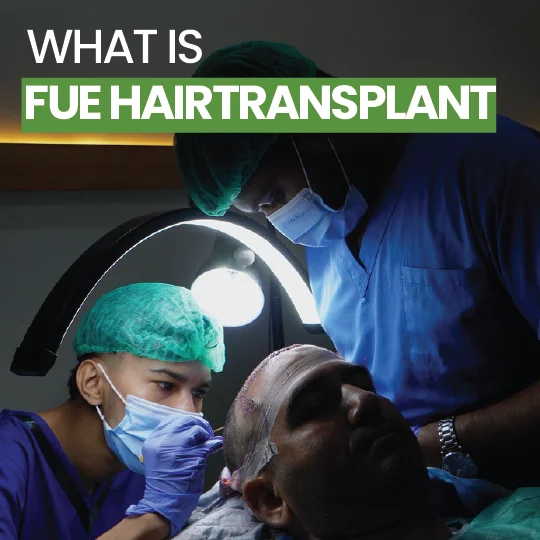
What Is FUE Hair Transplant — And How Is It Different?
FUE stands for Follicular Unit Extraction. It is a hair transplant method where the surgeon removes single hair follicles, one by one, from the back or sides of your scalp (called the donor area) and plants them into the bald or thinning spots.
Unlike older methods such as FUT (strip method), FUE does not cut a long strip of skin from your head. This means:
- No long scar on the back of your head
- Faster healing — most people return to work in 2–3 days
- Less pain during recovery
- You can keep your hair short after the procedure without hiding scars
Each hair follicle contains 1 to 4 strands of hair. The surgeon uses a small round tool (0.7–1.0 mm wide) to extract each follicle cleanly. These follicles are then planted in tiny openings made in the bald area, following your natural hair direction.
Medical note: The transplanted follicles are taken from the back of the scalp — an area that is genetically resistant to hair loss. This is why FUE results are considered permanent. The new hair grows just like normal hair and does not fall out due to the same reason you lost the original hair.
Who Is a Good Candidate for FUE Hair Transplant?
Not every person who is losing hair is a good candidate for surgery. A proper consultation is the only way to know for sure. But in general, FUE works well for:
You Are a Good Candidate If:
- You are a man or woman above 25 years old with stable hair loss
- Your hair loss follows a clear pattern — receding hairline, thinning crown, or bald patches
- You still have healthy hair at the back and sides of your scalp (donor area)
- You are in generally good health with no uncontrolled diabetes or blood pressure
- You want to fix a receding hairline, restore a bald crown, or add density to thin areas
- You want a beard transplant, eyebrow transplant, or sideburn restoration using FUE
FUE May Not Be Right for You If:
- Your hair loss is still spreading and not yet stable
- Your donor area is too thin or has very low hair density
- You have alopecia areata (patchy hair loss caused by an immune condition)
- You have certain medical conditions that affect wound healing
At Dot Clinics, Dr. Hamza Ahmad and Dr. Ayesha Malik examines your scalp under magnification during a free consultation. He will only recommend surgery if you are genuinely a good candidate — not just to sell a procedure.
How Much Does FUE Hair Transplant Cost in Lahore & Multan?
| Hair Loss Level | Grafts Needed | ICE FUE Cost | Chinese FUE + Sapphire | DHI |
|---|---|---|---|---|
| Mild (receding hairline) | 3000 grafts | PKR 70,000 | PKR 120,000 | Visit for pricing |
| Moderate (thinning crown) | 3500 grafts | PKR 75,000 | PKR 125,000 | |
| Advanced (large bald area) | 4000 grafts | PKR 80,000 | PKR 130,000 | |
| Severe (Norwood 5–6) | 4500 grafts | PKR 85,000 | PKR 135,000 | |
| Severe (Norwood 6–7) | 5000 grafts | PKR 90,000 | PKR 140,000 |
(All hair transplant procedures are performed under the supervision of a registered plastic surgeon as advised by the health commission.)
Important: These are estimated ranges. Your exact cost is decided during a free consultation after your scalp is examined. The same number of grafts may cost more or less depending on the complexity of your case and the technique used.
Check our Price for Hair Transplant in Pakistan page for a detailed breakdown of graft pricing, procedure options, and factors that affect overall cost.
What Is Included in the Cost at Dot Clinics?
- Pre-surgery consultation and scalp assessment
- Procedure performed by Dr. Hamza Ahmad (Plastic Surgeon)
- Local anesthesia and all surgical materials
- Post-surgery care kit and aftercare instructions
- Follow-up visit to check your healing progress
Dot Clinics does not charge hidden fees. The price you are quoted is the price you pay.
FUE vs DHI vs FUT — Which Method Is Better for You?
There are three main surgical methods for hair transplant. Each has a different technique, different ideal patient, and a different outcome. Here is how they compare:
| Feature | FUE | DHI | FUT (Strip) |
|---|---|---|---|
| Technique | Punch tool extracts each follicle | Choi implanter pen — no pre-cut slits | Strip of skin removed, sutured |
| Scarring | Tiny dots (hidden in short hair) | Tiny dots (hidden in short hair) | Linear scar (must keep hair long) |
| Recovery Time | 2–5 days | 2–5 days | 7–14 days |
| Best for | Most patients, flexible styling | High density, smaller areas | Large bald area, more grafts needed |
| Pain level | Low | Low | Moderate |
| Cost | Moderate | Higher than FUE | Lower per graft |
At Dot Clinics, we offer FUE and DHI. Dr. Hamza Ahmad and Dr. Ayesha Malik will recommend the right technique based on your scalp condition, the number of grafts needed, and your budget. You do not have to decide this yourself, it is part of the free consultation.
What Happens During an FUE Hair Transplant? (Step by Step)
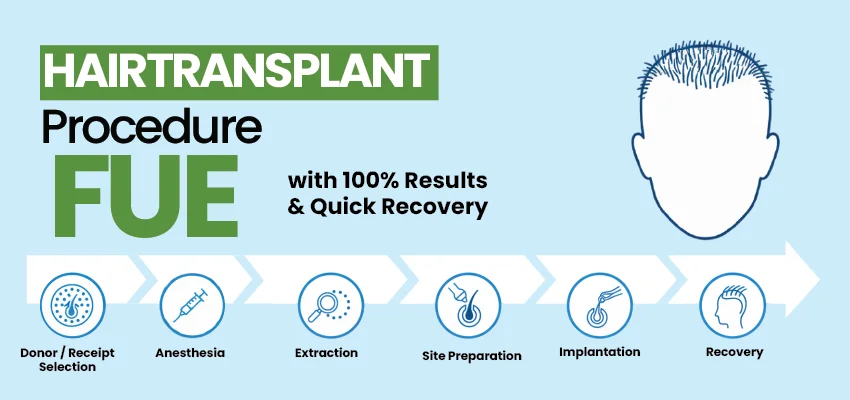
The full procedure usually takes 6 to 8 hours, depending on the number of grafts. Here is exactly what happens from the moment you arrive at the clinic:
-
Consultation & Design (30 min)
The surgeon examines your scalp and marks your new hairline. You discuss the design together and agree on the shape before anything is done. Photos are taken for your before/after record. -
Scalp Preparation & Anesthesia (30 min)
The donor area (back of the head) is trimmed short. Local anesthesia is injected — this is the only moment you feel a small sting. After that, the scalp is numb and you feel nothing. -
Follicle Extraction (3–5 hours)
The surgeon uses a motorized micro-punch tool (0.7–1.0 mm) to extract each hair follicle one by one. The grafts are placed in a special solution that keeps them alive and healthy until implantation. -
Recipient Site Preparation
Tiny openings (slits) are made in the bald area. The angle, depth, and direction of each slit is planned carefully to match your natural hair growth pattern. This is the most important step for getting a natural-looking result. -
Graft Implantation (2–3 hours)
Each extracted follicle is placed into the prepared slits. Single-hair grafts go along the hairline for a soft, natural edge. Multi-hair grafts go behind for density. The surgeon controls the exact placement of every single graft. -
Post-Procedure Care & Discharge (30 min)
You are given a post-care kit, written aftercare instructions, and a date for your follow-up visit. You can go home the same day. A family member should drive you, as the anesthesia may cause mild drowsiness.
We ensure strict hygiene standards and use the latest instruments to achieve clean, accurate, and lasting results.
To understand how a hair transplant works, it’s helpful to look at how different techniques restore growth. At Dot Clinics, we offer a range of hair transplant surgery in Pakistan, including both FUE and FUT methods. Each method gives you a natural-looking hairline.
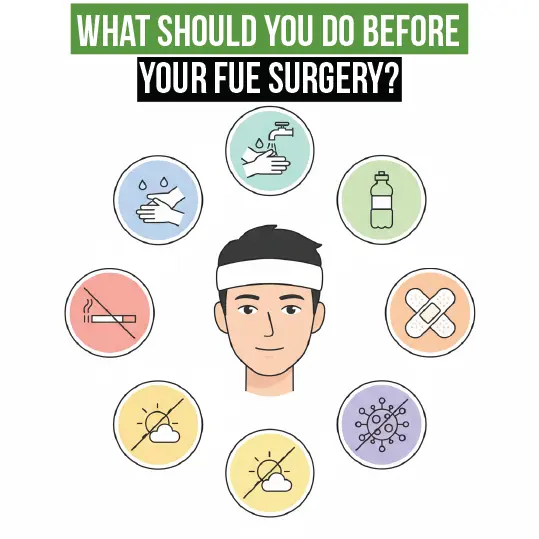
What Should You Do Before Your FUE Surgery?
Preparing properly before surgery reduces risks and improves your results. Follow these instructions starting one week before the procedure:
One Week Before:
- Stop taking aspirin, ibuprofen, or any blood-thinning medicines (ask your doctor before stopping any prescribed medication)
- Stop vitamin E supplements — these thin the blood and can cause more bleeding
- Avoid alcohol for at least 5 days before surgery
48 Hours Before:
- Stop smoking — nicotine reduces blood flow to the scalp and slows healing
- Avoid caffeine (tea, coffee, energy drinks) on the day before and day of surgery
On the Day of Surgery:
- Eat a normal meal before arriving — do not come on an empty stomach
- Wear a shirt that buttons or zips at the front — do not wear a pullover or t-shirt that goes over your head (this can disturb grafts)
- Arrange for someone to drive you home — do not drive yourself
- Wash your hair with regular shampoo the night before — no hair products on the day
What Happens After FUE? Week-by-Week Recovery Timeline
Recovery from FUE is straightforward, but understanding what is normal at each stage will stop you from worrying unnecessarily. Here is what to expect:
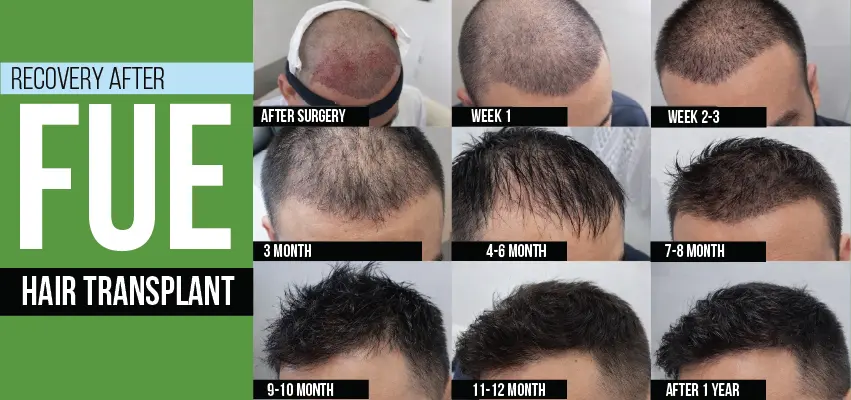
| Days 1–3 | Mild swelling of forehead and scalp. Small scabs form around each graft. Keep your head elevated when sleeping (use 2–3 pillows). Do not touch, rub, or wash your scalp during this period. |
| Days 4–7 | Scabs start to dry and loosen. You can begin gentle washing using the method shown to you by the clinic. Redness in the donor area begins to fade. Avoid sun exposure. |
| Weeks 2–4 | The transplanted hairs start to shed — this is called 'shock loss' and it is completely normal. The follicles are alive under the skin. Do not panic. This shedding does NOT mean the transplant failed. |
| Month 1–3 | The scalp looks quiet. Very fine, thin hairs may start to emerge. This is early growth and will thicken over time. Avoid strenuous exercise and direct sun on the scalp. |
| Month 3–6 | Visible hair growth begins. About 30–50% of your final result is visible by month 4–5. Hair is still thin but getting coarser and more natural looking. |
| Month 6–9 | Hair continues to thicken. By month 7–8, most patients can clearly see the transformation. You can style and cut your hair normally by this stage. |
| Month 9–12 | Final result. Hair is fully mature, dense, and natural-looking. The transplanted hair grows just like the rest of your hair — you can cut, colour, and style it freely. |
Why does shock loss happen? When hair follicles are moved to a new location, the hair shaft sheds while the follicle adjusts to its new blood supply. The root stays alive. New hair grows from the same follicle within 8–12 weeks. This is a normal part of the process — not a sign of failure.
Aftercare Instructions — What to Do and Avoid
| DO | AVOID |
|---|---|
| Sleep on your back, head elevated – reduces swelling and protects grafts | Touching, scratching, or picking at grafts – can dislodge follicles |
| Use clinic-provided spray/saline – keeps grafts hydrated (first 3 days) | Wearing hats, helmets, or tight caps (2 weeks) – puts pressure on grafts |
| Wash hair gently from day 4 as instructed – prevents infection & removes scabs | Swimming or soaking in water (4 weeks) – infection risk |
| Take prescribed antibiotics & anti-swelling meds – reduces infection risk | Intense exercise (2–3 weeks) – increases sweating & blood pressure |
| Direct sun exposure (4 weeks) – damages grafts & causes pigmentation | |
| Smoking (at least 4 weeks) – slows healing & blood supply |
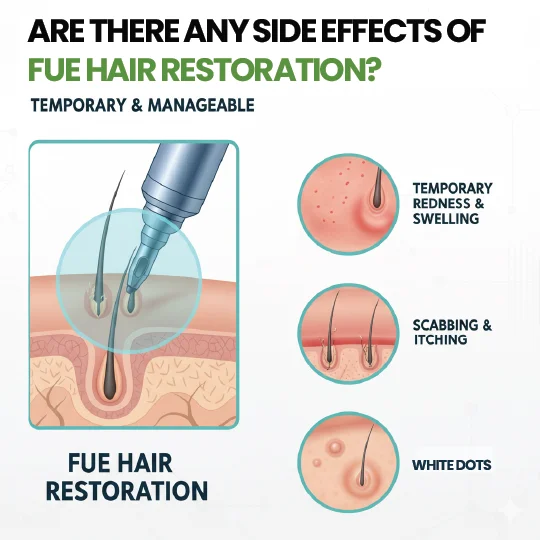
Are There Any Side Effects or Risks?
FUE is one of the safest cosmetic procedures available when performed by a qualified surgeon in a proper medical setting. However, like any surgery, minor effects can occur:
- Swelling of forehead or around eyes (3–5 days - normal, resolves on its own)
- Redness in donor and recipient areas (1–2 weeks)
- Scabbing around graft sites (7–10 days comes off during washing)
- Itching during healing (1–2 weeks do not scratch)
- Temporary shock loss of transplanted hair (Weeks 2–6 hair regrows, this is normal)
- Temporary numbness in the scalp (Up to 3 months)
- Tiny white dots in the donor area (Puts pressure on grafts)
- Touching, scratching, or picking at grafts (Permanent but invisible in most hair lengths
Serious complications — such as infection, significant scarring, or graft failure are rare and usually result from choosing an unqualified provider. At Dot Clinics, every procedure is performed under sterile conditions by Dr. Hamza Ahmad a certified plastic surgeon and Dr. Ayesha Malik a certified dermatologist, they are performed thousands of hair transplants in Pakistan.
What Results Can You Expect? Success Rate & Realistic Outcomes
FUE is one of the most effective permanent solutions for hair loss. Here is what the evidence and clinical experience shows:
- Success rate: 90–98% graft survival in experienced hands
- Permanence Permanent transplanted follicles are taken from DHT-resistant zones
- Natural look Yes — surgeon controls angle, direction, and density of each graft.
- Time to see results 30% visible at 4 months, 70% at 8 months, full results at 12 months
- Can it fail? Graft failure rate is under 2% at skilled clinics with proper aftercare
- Will hair fall again? Transplanted hair is permanent. Non-transplanted existing hair may still thin with age — medical treatment (PRP, Minoxidil, Finasteride) can protect it.
Honest answer: FUE gives permanent, natural-looking hair. But it is not a cure for all hair loss. The untreated hair around the transplanted area can still thin over time. That is why a good surgeon will plan your hairline conservatively, keep donor area in reserve, and sometimes recommend medical treatment alongside surgery.
Who Will Perform Your FUE Hair Transplant?
Your hair transplant at Dot Clinics is performed by Dr. Hamza Ahmad — an Aesthetic Plastic Surgeon in Lahore and Dr. Ayesha Malik - an Aesthetic physician & dermatologistin Multan specialising in FUE and DHI hair restoration.
| Doctors | Dr. Hamza Ahmad | Dr. Ayesha Malik |
|---|---|---|
| Qualification | MBBS | FCPS (Plastic Surgery) | M.B.B.S | MCPS |
| Specialisation | FUE hair transplant, DHI hair transplant, facial aesthetic surgery | Aesthetic Dermatologist, Skin Specialist |
| Experience | Thousands of hair transplant procedures performed across Pakistan | 3+ Years of Experience |
| Clinics | Dot Clinics Lahore (Johar Town) & Dot Clinics Multan (Abdali Road) | Dot Clinics (Pakistan) |
| Consultation Type | Free, in-person scalp assessment — no obligation to book | Free, in-person consultation — no obligation |
Dr. Hamza Ahmad and Dr. Ayesha Malik personally performs every step of the procedure, from hairline design to graft implantation. He does not delegate surgery to a technician.
A hair transplant is a medical procedure that permanently changes your appearance. It should be performed by a qualified surgeons, not a technician or beautician. Always confirm the qualifications of the person performing your surgery before booking.
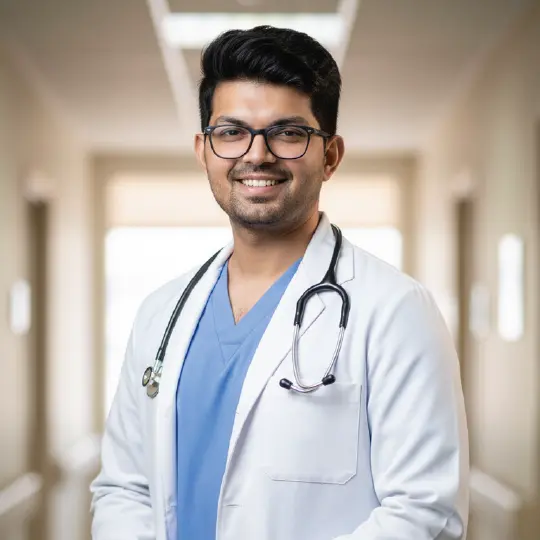
Dr. Hamza Ahmad
Plastic Surgeon & Hair Transplant Specialist
The content of this page is for informational purposes only.
Please consult with our Plastic Surgeon for diagnosis and treatment.
FUE HAIR TRANSPLANT FAQ's
The procedure itself is not painful. Local anesthesia is injected into the scalp before anything else is done. You may feel a small sting from the anesthesia needle — that is usually the most uncomfortable moment. During the actual extraction and implantation, you feel pressure and movement but no pain. After the surgery, the scalp may feel sore and tight for 2–3 days, similar to sunburn. This is managed with mild pain relief prescribed by the clinic.
New hair begins to grow at around 3–4 months after surgery. By 6 months, you will see a noticeable improvement. Full results — with maximum density and mature hair texture — are visible between 10–14 months. The wait is frustrating for most patients, but the final result is worth it.
Yes. The hair follicles transplanted during FUE come from the back of the scalp — an area that is not affected by the hormone DHT, which causes male pattern baldness. Because of this, the transplanted follicles do not fall out. They grow for life, just like natural hair.
Shock loss is when the transplanted hairs fall out 2–6 weeks after surgery. It happens because the hair shaft goes into a resting phase when the follicle is moved. The follicle itself remains alive. New hair grows back from the same follicle within 8–12 weeks. Shock loss is completely normal and expected — it is not a sign that the transplant has failed.
Yes. Women with a stable pattern of hair thinning (especially at the crown or hairline) are good candidates for FUE. Women experiencing diffuse hair loss across the entire scalp may not be suitable candidates, as they may not have a strong enough donor area. This is assessed during the free consultation.
In FUE, the surgeon first makes tiny slits in the recipient area, then implants the grafts into those slits. In DHI, a special pen-like tool (Choi implanter) is used to extract and implant the graft in one step — without making pre-cut slits. DHI can give slightly higher density in smaller areas and is a bit more precise. FUE covers larger areas more efficiently. At Dot Clinics, Dr. Hamza Ahmad recommends the right method after examining your scalp.
The number of grafts depends on the size of the bald area and how dense you want the result to look. A mild receding hairline may need 800–1,500 grafts. A full crown restoration may need 2,500–4,000 grafts. An exact count is given after a free scalp assessment at the clinic.
In experienced hands with proper technique and aftercare, graft survival rate is 90–98%. This means nearly all planted hair follicles take root and produce permanent hair. The overall satisfaction rate for FUE surgery at reputable clinics in Pakistan is high. Failure is almost always linked to choosing an under-qualified provider or not following aftercare instructions.
Yes. Dot Clinics operates in both Lahore and Multan. Patients from Karachi, Islamabad, Rawalpindi, and other cities also travel to our clinics for consultation and surgery. Contact the clinic to discuss your location and schedule a consultation.
The extracted follicles do not grow back in the donor area — they have been moved permanently. However, because FUE extracts follicles spread across a wide area (not a strip), the thinning in the donor area is not visible. The remaining hair in the donor area covers the tiny extraction sites, and the back of the scalp continues to look full and natural.