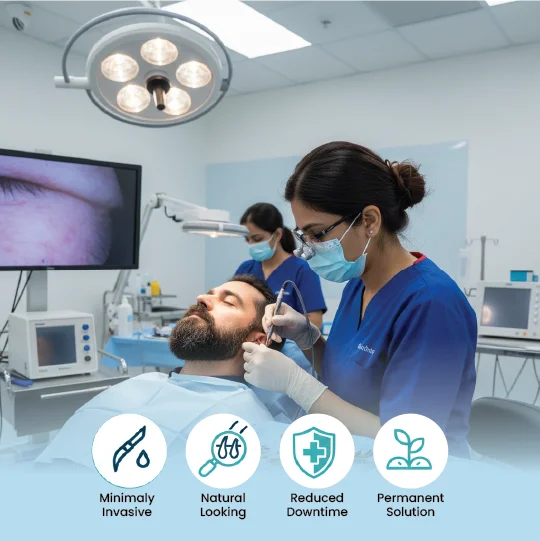
Beard Hair Transplant
A Patchy Beard - Is Not Permanent.At Dot Clinics, we restore natural, full beard growth for men in Lahore and Multan using the FUE technique — no linear scars, no downtime beyond a few days, and results that last a lifetime.
- FUE technique only — no strip scars
- Clinics in Lahore & Multan
- Transparent pricing — no hidden charges
- Free consultation before any commitment
We Understand Your Frustration
You Have Tried Everything. Nothing Has Worked
If those words sound familiar, you are not alone. Millions of men across Pakistan, in Lahore, Multan, and beyond, struggle with sparse, uneven, or completely absent beard growth. It is not a willpower problem. It is not a grooming failure. It is biology.
The cause is almost always genetic. Some men's facial follicles are simply not programmed to produce terminal (thick) hair. No oil, no supplement, and no "natural remedy" changes the DNA of an inactive follicle.
That is where beard hair transplant surgery steps in - and it is the only clinically proven, permanent hair solution for men whose beard follicles are inactive or absent.

What Is a Beard Hair Transplant?
A beard hair transplant is a minimally invasive surgical procedure that moves healthy, permanent hair follicles from a donor area (typically the back of the scalp) and implants them into the face to create or restore beard growth.
The transplanted follicles are genetically resistant to loss and grow permanently in their new location.
At Dot Clinics, we perform beard transplants exclusively using the Follicular Unit Excision (FUE) method, the gold standard recommended by the International Society of Hair Restoration Surgery (ISHRS). No strip. No linear scar. No shaved head required.
Who Is This Procedure For?
A beard hair transplant is suitable for a specific range of patients. During your free consultation at Dot Clinics, we assess your individual situation before making any recommendation.
Patchy beard
Uneven growth on cheeks, jaw, or chin that does not fill in despite age or time.
Genetically thin beard
Fine or almost invisible facial hair present but too thin to look like a beard
Scar correction
Acne scars, surgical scars, burns, or injury damage that left hairless patches.
Alopecia barbae
An autoimmune condition causing localised circular patches of beard hair loss.
Mustache restoration
Absent or thinning mustache growth that affects symmetry and facial appearance.
Density enhancement
Existing beard present but too sparse — adding grafts for a fuller, denser result.
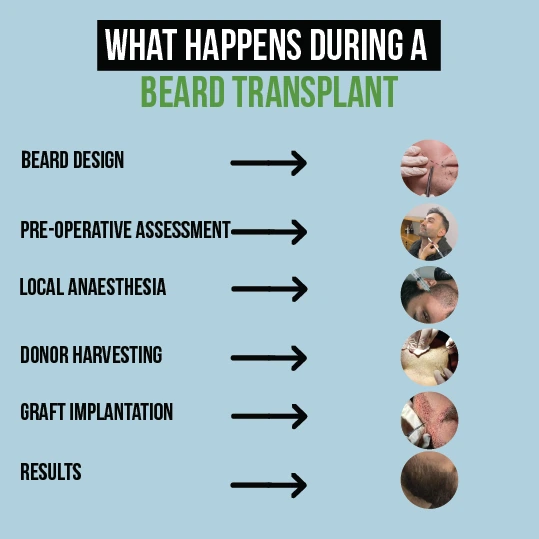
What Happens During a Beard Transplant at Dot Clinics?
Every step is designed with your comfort and result quality in mind. Here is exactly what to expect from your first appointment to your final follow-up.
-
Free consultation and beard design
We assess your donor hair quality, discuss your beard goals zone by zone (goatee, full beard, mustache, sideburns), and give you an honest graft estimate with transparent pricing. No obligation. -
Pre-operative assessment
Blood work, scalp and donor area evaluation, and a review of your medications and health history. This step exists to protect your safety and confirm candidacy before surgery is scheduled. -
Local anaesthesia
Tumescent local anaesthesia is applied to the donor area (scalp) and the recipient area (face). The injection itself lasts 30–60 seconds and is the most uncomfortable moment of the entire session. After this, you should feel pressure only — not pain. -
FUE donor harvesting
Individual follicular units are extracted from the back of the scalp using a precision punch tool (typically 0.7–0.9 mm diameter). The number of grafts ranges from 500 to 2,500 depending on the coverage area. No strip. No linear scar. -
Recipient site creation and graft implantation
Micro-channels are created in the face at the precise angle, depth, and direction that mimics natural beard growth. Grafts are then placed. Correct angulation — typically 30–45 degrees — is what makes a transplant look real rather than artificial. -
Post-operative care and follow-up
Detailed written aftercare instructions are provided. You attend a check-up at day 7, and again at months 3, 6, and 12. We monitor your result and address any concerns at every stage. You are never left on your own after surgery.
How Many Grafts Do You Need?
Graft count depends entirely on which beard zones you want to cover and how dense you want the final result. The table below reflects standard clinical ranges — your exact number is confirmed at consultation.
| Beard Zone | Approximate Graft Range | Typical Coverage Goal |
|---|---|---|
| Full beard (all zones) | 1,800 – 2,500 grafts | Complete facial coverage |
| Cheeks only | 600 – 1,000 grafts | Fill sparse cheek areas |
| Goatee area | 700 – 1,100 grafts | Chin and below lip |
| Mustache only | 350 – 550 grafts | Upper lip line |
| Jaw and neckline | 400 – 800 grafts | Definition and shape |
| Scar correction only | 200 – 600 grafts | Localised patch filling |
Source ranges based on ISHRS clinical guidance. Your exact graft count is determined by donor hair density and individual coverage goals — assessed free of charge at Dot Clinics.
What to Expect After Your Beard Transplant
We want to be completely honest with you about the recovery process — because the most common source of post-operative anxiety is not being prepared for what normal healing looks like.
Days 1 – 5
Redness and scabbing
Normal healing. Mild swelling, redness, and tiny crusts around grafts. Keep moist with saline. Do not touch.
Weeks 2 – 6
Shock loss begins
Transplanted hairs shed. This is expected and normal. The follicle remains alive beneath the skin. Do not panic.
Months 1 – 3
Dormant phase
Minimal visible growth. Follicles are establishing blood supply. Patience is required. Results are coming.
Months 4 – 6
Regrowth emerges
New, fine hairs begin appearing. Growth accelerates. You will start to see the shape of your new beard.
Months 9 – 12
Final result visible
Full density achieved. Hair grows, behaves, and can be shaved and shaped exactly like natural beard hair.
Density enhancement
Existing beard present but too sparse, adding grafts for a fuller, denser result.
Shock Loss
The shedding of transplanted hair in weeks two through six — is the single most distressing part of the recovery for most patients. It looks like the transplant is failing. It is not.
The hair shaft falls away, but the follicle remains implanted and alive. This is a well-documented, predictable phase of the hair growth cycle. New hair from that same follicle emerges within 8–12 weeks. Understanding this in advance makes the experience far less stressful.
If shedding is significantly asymmetric or continues past the 10-week mark, contact Dot Clinics. That warrants a clinical review, but it is rarely a sign of failure.
What to Do and What Not to Do
Your result depends as much on your aftercare as on the surgery itself. Follow these instructions exactly as given by your Dot Clinics surgeon.
What to do
✅ Sleep with head elevated at 30–45° for the first five nights to reduce swelling
✅ Use the prescribed saline spray and gentle patting technique from day two
✅ Keep the recipient area fully out of direct sunlight for at least four weeks
✅ Attend every scheduled follow-up appointment without exception
✅ Stay well hydrated and maintain a protein-rich diet during recovery
✅ Call Dot Clinics immediately if you notice signs of infection
What not to do
❌ Do not touch, rub, or scratch the grafted area for the first two weeks
❌ Do not shave the recipient area until your surgeon explicitly clears you (usually day 10–14)
❌ Do not exercise intensely or increase heart rate significantly for 10 days
❌ Do not apply any oil, balm, or grooming product without clinical approval
❌ Do not smoke — nicotine measurably reduces graft survival by restricting blood flow
❌ Do not swim in pools or natural water for at least three weeks
Source ranges based on ISHRS clinical guidance. Your exact graft count is determined by donor hair density and individual coverage goals — assessed free of charge at Dot Clinics.
Contact Dot Clinics Without Delay If You Have:
- Increasing pain after day 3, normal recovery pain decreases. Pain that worsens after three days is not normal.
- Signs of infection, thickening or pus-like discharge, expanding redness spreading beyond the graft zone, or fever above 38°C.
- Symmetric or concentrated graft loss beyond the four-week mark that does not affect both sides equally.
- Persistent numbness in the donor area lasting longer than three weeks after the procedure.
- Sudden diffuse scalp hair loss spreading across the entire scalp following beard transplant surgery.
- Any symptom that instinctively feels wrong to you — we would rather you call once and be reassured than wait and have a preventable complication worsen.
Beard Transplant Cost in Pakistan
Beard transplant pricing in Pakistan varies based on the number of grafts required and the clinic's level of surgical expertise. At Dot Clinics, we use a transparent per-graft pricing model — you only pay for what you actually need.
| Graft Range | Typical Coverage | Pricing Model |
|---|---|---|
| 300 – 700 grafts | Scar correction / mustache | Per-graft rate — quoted at consultation |
| 800 – 1,200 grafts | Partial beard / cheek fill | Per-graft rate — quoted at consultation |
| 1,500 – 2,500 grafts | Full beard coverage | Per-graft rate — quoted at consultation |
Dot Clinics does not publish fixed package prices online because graft count varies per patient. Every quote is based on your actual clinical assessment — never a generic package.
Get Your Exact Price Estimate — Free
Your consultation at Dot Clinics is completely free. We assess your donor area, estimate your graft count, and give you a full transparent cost breakdown with no pressure and no obligation.
Frequently Asked Questions
Direct answers to the questions we hear most from patients in Lahore, Multan, and across Pakistan.
Yes. Transplanted follicles come from the DHT-resistant donor zone at the back of the scalp. They retain this genetic resistance after transplantation. According to ISHRS clinical guidance, results are considered permanent — the hair grows for life, behaves like normal beard hair, and does not fall out.
The procedure is performed under local anaesthesia. The brief discomfort of the anaesthesia injection — lasting approximately 30–60 seconds — is the most uncomfortable moment. During extraction and implantation, patients feel pressure and mild pulling but not pain. Post-operative discomfort is mild and managed with standard pain relief for one to three days.
Most patients are socially presentable within seven to ten days. Shock loss (temporary shedding) occurs in weeks two to six and is normal. Regrowth begins at months three to four. Final density is visible at nine to twelve months. You can return to office work within two to three days for most patients.
A full beard typically requires 1,800 to 2,500 grafts. Partial coverage — goatee only, mustache only, or cheek fill — requires significantly fewer grafts. Your exact count is assessed at your free consultation at Dot Clinics Lahore or Multan.
Yes. Dot Clinics operates in both Lahore and Multan. Patients from Multan and surrounding areas can book their free consultation at our Multan branch for a full assessment and pricing without needing to travel to Lahore.
Yes — exactly like your natural beard. Transplanted hair grows continuously, can be trimmed and shaped, and responds to shaving normally. This is one of the most satisfying aspects of the result for our patients. The beard becomes entirely yours to style.
FUE leaves tiny, scattered punctate marks (approximately 0.7–0.9 mm each) rather than a linear scar. These are not visible to the naked eye once the scalp hair grows back — typically within four to six weeks. You can cut your hair short without any visible scarring.
Dr. Hamza Ahmad
Plastic Surgeon & Hair Transplant Specialist
The content of this page is for informational purposes only.
Please consult with our Plastic Surgeon for diagnosis and treatment.