

Peyronies Disease is a condition in which fibrous scar tissue form inside the penis causing it to bent and curved during an erection. This curve can be mild severe which may lead to pain, problems during sexual activity and emotional stress. Receiving the right clinical analysis is very crucial because it helps doctors understand how critical is the condition and what treatment is best for you. Many men feel hesitant to talk about this issue but initial diagnosis can prevent the condition from getting worse.
The primarily cause of Peyronie’s disease is repeated micro-trauma or injury to the penis, often during vigorous sex, causing scar tissue (plaque) to form on the elastic sheath (tunica albuginea).
Understanding the Early Signs
Before diagnosis it is important to notice the early symptoms of Peyroniese Disease. most common sign is a curve in the penis during erection. Some men also feel lumps and hard areas under the skin. Pain during erection is another early symptom especially in the initial stage of the condition. In some cases men may observe condensing of the penis and issue in preserving an erection. These signs should not be neglected as they help doctors make a correct diagnosis.
Medical History and Discussion
First step in evaluation of Peyronie’s Disease is extensive conversation with the doctor. The doctor will ask about symptoms that how long they have been present and whether the curve is getting worse. You may also be asked about any past injuries to the penis like trauma is a common cause of this condition. This discussion assists the doctor to figure out the stage of the disease and how it is affecting daily life.
It is important to answer honestly and clearly during this step. Even though it may feel uncomfortable sharing accurate information helps in better diagnosis and treatment planning.
Physical Examination
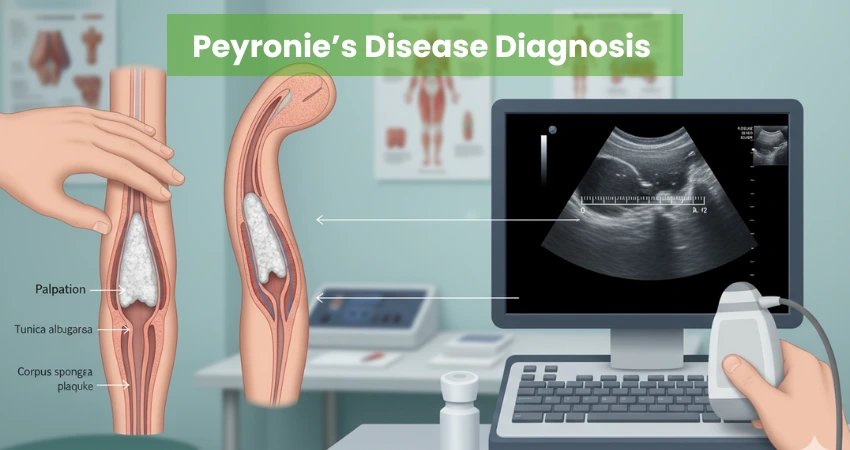
After the discussion doctor usually performs a physical examination. This involves checking the penis for any hard lumps and plaques under the skin. The doctor may gently feel the shaft of the penis to identify the location and size of the scar tissue.
Sometimes the examination is done when the penis is not erect. However in certain cases the doctor may need to see the penis in an erect state to better understand the curve. This helps in measuring the angle and severity of the bending.
Imaging Tests
In some cases doctors may suggest imaging tests to ensure the diagnosis. The most common test used is ultrasound. This test is simple, comfortable and grants clear images of the iner structure of the penis.
Ultrasound helps in identifying the exact location of the scar tissue and checking blood flow. It can also show whether the plaque is hardened or still developing. This information is beneficial for deciding the right treatment for you.
In rare cases other imaging methods may be used but ultrasound is commonly sufficient for most of patients.
Measuring the Curvature
To properly diagnose Peyronie’s Disease the doctor needs to measure the degree of curvature. This is often done by asking the patient to provide a photo of the erect penis taken at home. In some clinics medication may be used to create an erection for examination.
Measuring the curve helps in understanding how severe the condition is. A mild curve may not require aggressive treatment while a severe curve may need medical and surgical intervention.
Identifying the Stage of the Disease
Peyronie’s Disease has two main stages the acute (early) stage and the chronic (stable) stage. During the acute stage patients may feel pain and the curve may continue to change. In the chronic stage the pain usually decreases and the curve becomes stable.
Identifying the stage is important because treatment options vary. For example medications may work better in the early stage while surgery is usually considered in the stable stage.
Psychological Impact
Diagnosis is not only about physical symptoms. Doctors also think about sentimental and mental impacts of the condition. Many men experience stress, lack of confidence and mental stress due to variations in their sexual wellness.
Discussing these concerns are important because they are part of the overall medical evaluation. Proper support and counseling may be recommended along with medical treatment.
Why Early Diagnosis Matters
Early diagnosis of Peyronie’s Disease can make a big difference. It allows doctors to start treatment before the condition becomes severe. It also helps in cutting down problems that arise such as severe curvature and erectile dysfunction.
Ignoring symptoms can lead to worsening of the condition making treatment more difficult later. That is why it is always better to seek medical advice as soon as any unusual changes are noticed.
FAQs
1. How is peyronies disease first detected?
It is usually detected through symptoms like penile curvature pain during erection lumps under the skin. A doctor confirms it through medical history and physical examination.
2. Is ultrasound necessary for diagnosis?
Not but it is often used to get a clear view of scar tissue and blood flow. It helps in more accurate diagnosis.
3. Can Peyronie isease be diagnosed at home?
You can notice symptoms at home but proper diagnosis requires a doctor’s evaluation and sometimes imaging tests.
4. Does the condition get worse if not diagnosed early?
Yes in many cases the curve can increase and symptoms may become more severe if not treated on time.
5. Is diagnosis painful?
No diagnosis process is usually simple and not painful. Physical examination and ultrasound are generally comfortable procedures.