


Erectile dysfunction (ED) affects millions of men in whole world. Yet one of its lesser known but clinically significant causes venous leak remains underdiagnosed. Also known as corporoveno occlusive dysfunction. Venous leak occurs when the veins of the penis fail to restrict blood outflow slowly during an erection which makes it difficult to achieve and maintain rigidity. Exact diagnosis is the foundation of reliable treatment and developments in diagnostic technology that have made it increasingly possible to detect this condition with accuracy.
Understanding Venous Leak: A Brief Overview
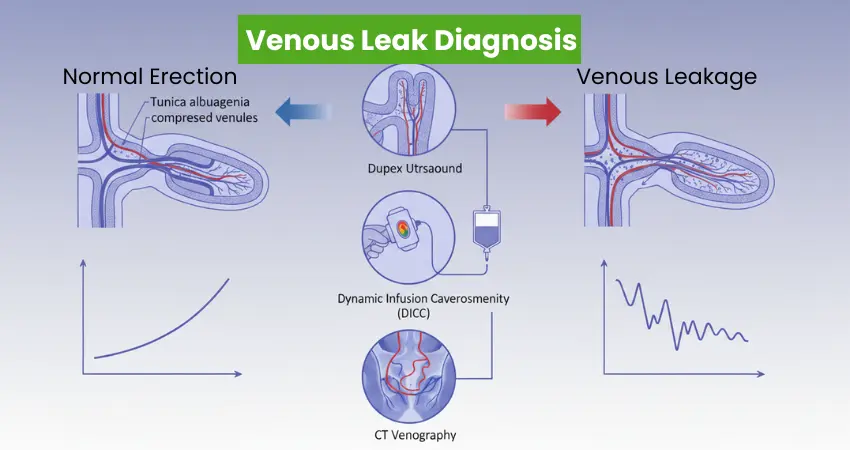
An erection happens when a series of steps work together in the blood vessels. Blood, from the arteries flows into the corpora cavernosa. This makes the smooth muscle relax and get bigger. The corpora cavernosa then press on the veins called subtunical venules against a layer called the tunica albuginea. This process, known as the veno occlusive mechanism that helps to trap blood and keeps the erection going. The corpora cavernosa and veno occlusive mechanism work together to maintain the erection.
Sudden or rapid loss of erection is basic known symptoms of venous leak. When we talk about leak the thing that usually stops blood from flowing out breaks down. The blood then gets out soon through the veins that are not working right and the erection either does not get fully hard or it goes away really fast. This happens because of the venous leak and it is a problem, with the veins that are supposed to keep the blood in. The venous leak causes the blood to escape. That is why the erection does not last.
The First Step in Diagnosis
Doctors start by carefully listening to your medical history before doing any tests. This is very important because it gives early clues about your problem. They usually ask about.
Quick loss of erection means erection goes away within a few minutes even if arousal is still there
Difficulty in keeping erection during sex unless there is constant stimulation
Morning erections, if they are still present it may suggest a psychological cause along with a physical one
Past health problems like pelvic injury, Peyronie’s disease and penile surgery
Risk factors such as diabetes, high blood pressure and smoking which can damage to your blood vessels with the pessage of time.
Doctors may also use simple evaluation forms to understand how severe the erectile dysfunction is.
Colour Doppler Ultrasound (Main Test)
The most common and important test for suspected venous leak is the penile Colour Doppler Ultrasound.
It is
- Non-invasive (no surgery)
- Safe and widely available
- Done in real time while checking blood flow
How the test is done.
- A small injection is given in the penis to create an artificial erection
- Then ultrasound is used to measure blood flow inside penile arteries and veins
What doctors check
Blood inflow speed (PSV)
If it is low it may mean poor blood supply
Blood leakage (EDV)
If blood continues to flow out when the penis is firm it suggests venous leak
Resistance level (RI)
Low resistance means blood is not being trapped properly inside the penis
Simple meaning
In a normal erection, blood enters and gets “stuck” inside.
In venous leak, blood enters but leaks out too quickly, so erection cannot stay firm.
Cavernosometry and Cavernosography (Advanced Test)
If ultrasound results are not clear and surgery is being considered doctors may use more advanced tests.
Cavernosometry
- Measures how much fluid is needed to maintain an erection
- If a high amount is needed it suggests venous leak
Cavernosography
- A special dye is injected
- X-ray imaging shows exactly where blood is leaking from
- Helps doctors find the exact weak veins causing the problem
Why it is useful
It gives a detailed map of the leakage which helps if surgical treatment is planned.
MRI and Advanced Scans
In some cases doctors may use MRI scans of the pelvis and penis.
This is helpful when
- Peyronie’s disease is suspected
- There is scarring or fibrosis
- There was a past injury
MRI helps doctors see
- Penile tissue health
- Plaques or scar tissue
- Structural damage affecting erection
Hormonal and Psychological Check
Venous leak is not always only a physical problem. Doctors also check other factors.
Hormone tests
- Testosterone level (low levels can reduce sexual function)
- Prolactin levels
- Thyroid function
Psychological factors
- Stress, anxiety or performance pressure can also affect your erections and sometimes look like venous leak.
- That is why both mind and body are checked together.
Conclusion
Venous leak is more common than people think and it can be managed once properly diagnosed. If a man has erections that fade quickly despite of desire he should see a specialist for proper testing.
Early diagnosis helps to avoid wrong treatments, know about main cause of venous leak, and gives a better chance of successful recovery and improved confidence.
FAQs
Q1 When should a man get checked for venous leak?
If erections go away very quickly and cannot stay firm during intercourse even with strong arousal a doctor should evaluate for venous leak.
Q2 Is venous leak surgery always needed?
No. Many cases are managed without surgery using medications, lifestyle changes and other treatments depending on severity.
Q3 Can venous leak be treated without surgery?
Yes in many cases. Treatment may include medicines, vacuum devices, and lifestyle improvements. Surgery is only for selected severe cases.
Q4 Is venous leak permanent?
Not always. Some cases improve with treatment especially if the cause is related to lifestyle, hormones and early vascular issues.
Q5 Can stress cause similar symptoms?
Yes. Anxiety and stress can reduce erection quality and sometimes mimic venous leak that is why psychological evaluation is important.